Efficiency and speed in storm damage repairs
Hurricane Helene, which struck the south-eastern parts of the United States, caused immense damage to forests and more widely to the economy. Especially in the State of Georgia, forests and their owners were hit hard. Large-scale repairs of storm damage are now underway, in which PONSSE machines have proven their value in efficient and sustainable harvesting.
Hurricane Helene hit the south-eastern parts of the United States in late September 2024. Continuous winds of more than 220 km/h at their highest caused immense material damage. Hurricane Helene landed in Florida and then passed through Georgia, also hitting Tennessee, North Carolina and Virginia.

“The force of such a storm extending this far inland is unprecedented,” says Lee Miller who is currently repairing forest damage in Georgia.
There is more than enough work to be done to repair storm damage in the southeast
after strong winds and heavy rains cut down trees and caused record-breaking flooding. Not even well-tended forests had any chance of avoiding the storm’s devastation.
In Georgia, for example, the storm damaged about 8.9 million hectares of forests – almost 40% of the state’s forestry areas. The most serious damage was experienced in an area of about 1.47 million hectares. It has been calculated that the total damage to Georgian forestry amounted to USD 1.28 billion.
A forest machine operator optimises quality and finds defects
After Helene weakened, contractors across the United States were invited to take care of the most urgent work: clearing roads and removing trees fallen over houses. Many contractors who operate PONSSE machines are still working to repair the storm damage in several states, says Timo Savornin, Marketing Director at Ponsse.
A low surface pressure and excellent tree processing capabilities make Ponsse an
effective workhorse when harvesting fallen trees in the soft grounds of Florida and
Georgia. PONSSE forest machines are based on the environmentally friendly cut-to-length (CTL) method, which offers better optimisation compared to the full tree length (FTL) method, which is commonly used in North America.
Market fluctuations in the forest industry cause US professionals to move to different
parts of the country, always according to the situation. However, Lee Miller, who is working on the logging sites of Georgia, and his company Miller Timber Services were
already in the area and its logging sites before the storm hit.
“We believe in versatility and wanted to expand into new markets, which is why we decided to come here.”
According to Lee Miller, information about storm damage sites and opportunities is mostly spread by word of mouth. Someone knows someone, while someone drives past a damaged area and tells others about what they have seen.
Smooth going — also in wet terrain
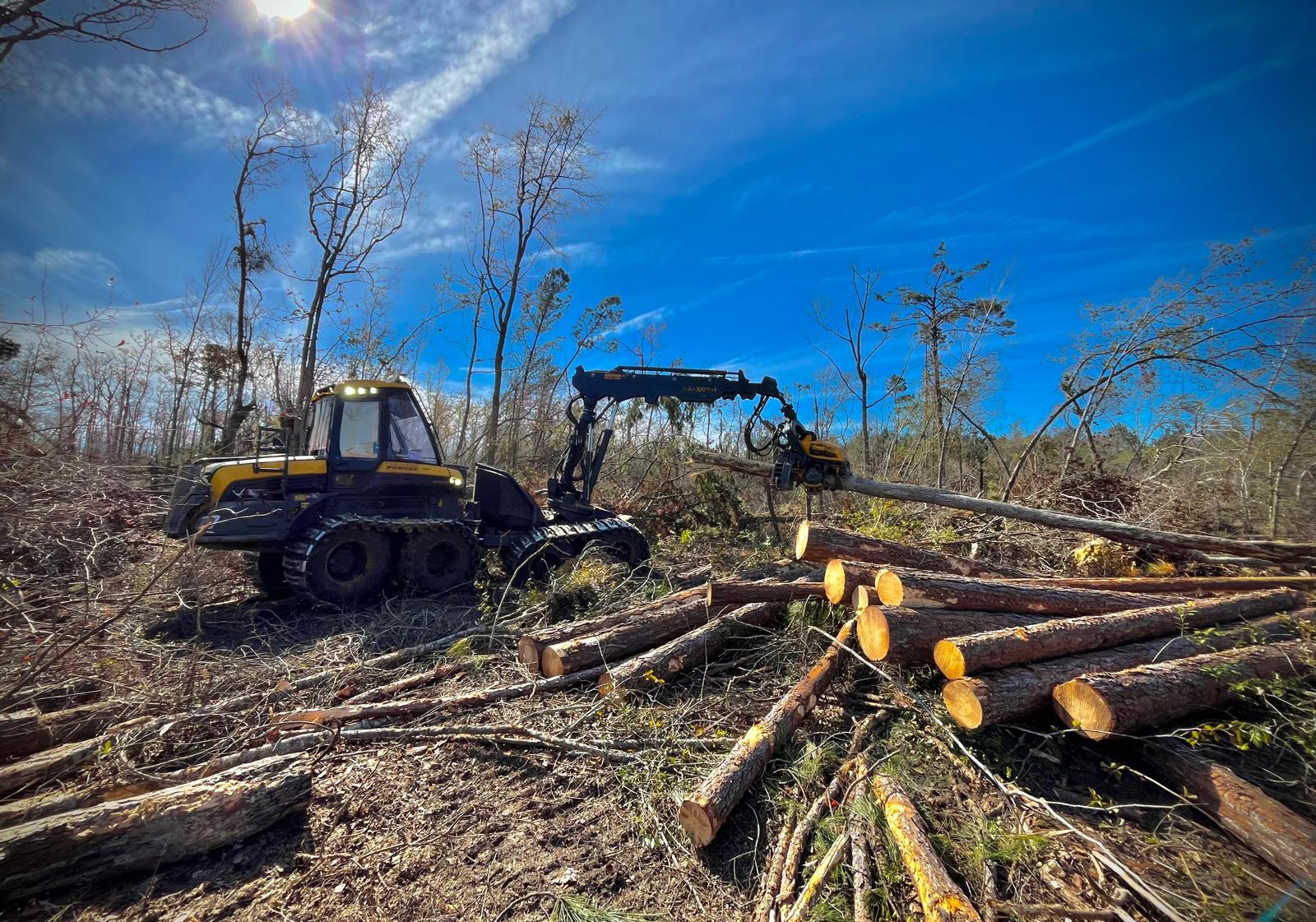
Miller’s team is harvesting fallen pine trees that are delivered to both pulp and veneer mills. They are operating an Ergo harvester equipped with the H7 harvester head and a
Buffalo forwarder. Georgia’s flat and wet terrain is a rarer operating environment for men accustomed to working on slopes. However, they praise PONSSE forest machines for their ability to adapt to different terrain types.
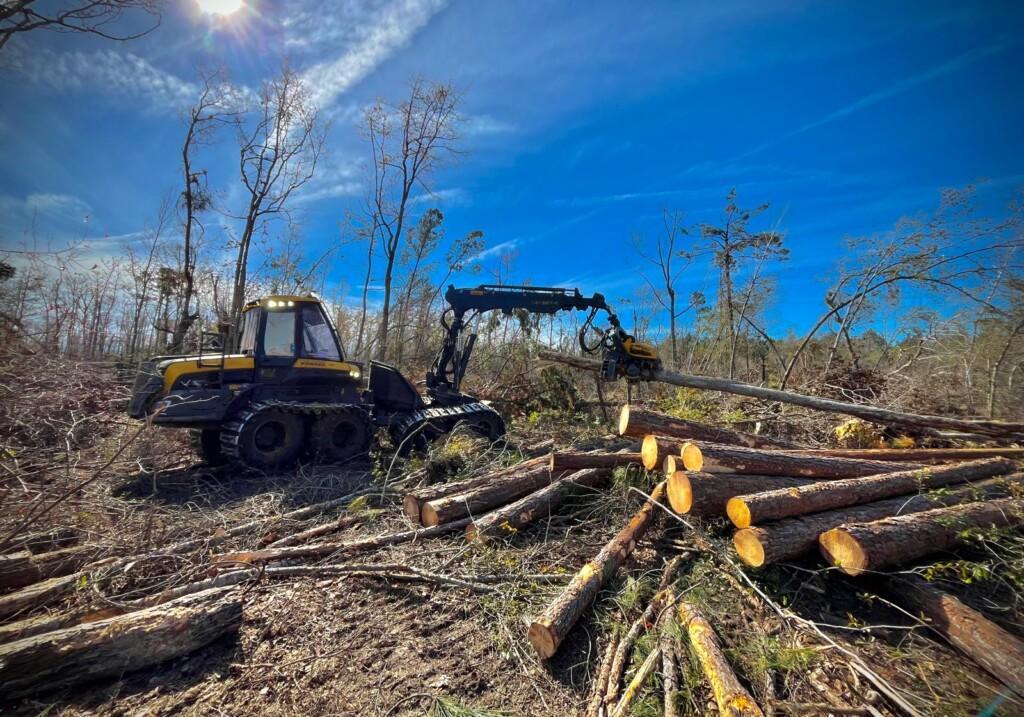
“PONSSE machines equipped with wheels and tracks that follow the terrain can move in
a soft and difficult terrain where local heavy track-based harvesters cannot operate. This is crucial in wet damage areas,” Miller says.
What makes Ponsse and the CTL method clearly stand out is the ability to lift, move
and process fallen trees. The harvester head can effectively process trees lying on the
ground while saving valuable timber. This allows trees to be sorted correctly: the best
saw logs will be delivered to sawmills and other stems to pulp mills.
“We can process trees better – the harvester head helps us make higher quality logs from damaged, topless or bruised trees. Trees can be used as completely as possible,” Miller says.
According to the men’s estimates, recovering from the storm and clearing the damaged forests will take at least two years. They also work against the clock, as tree discolouration can quickly spoil fallen trees.
“PONSSE forest machines help us optimise, pick up and sort fallen stems into sawn logs and pulpwood before the value of timber decreases. This is important to ensure that landowners get the best possible return on their trees.”
